

Workout Frequency Calculator
This tool helps determine your ideal workout frequency based on science-backed recommendations for men. Choose your age and activity level to get personalized guidance.
Your Optimal Schedule
Recommended frequency: sessions per week
Based on your age and activity level, this schedule prioritizes recovery while maintaining strength and vitality. Remember: recovery isn't optional—it's part of the training.
There’s a quiet myth that more is better - that crushing five, six, even seven workouts a week is the mark of discipline. But real strength isn’t measured in sweat-soaked days. It’s measured in consistency, recovery, and long-term resilience. For most men, especially those juggling careers, family, and personal growth, the question isn’t how many times to work out - it’s how wisely.
What Science Actually Says
Major health organizations - the World Health Organization, the American College of Sports Medicine - agree on a simple baseline: adults should aim for at least 150 minutes of moderate-intensity aerobic activity per week. That breaks down to about 30 minutes, five days a week. For strength training, the recommendation is two sessions targeting all major muscle groups.
But here’s what most people miss: these are minimums. They’re the floor, not the ceiling. For a man in his 30s or 40s who wants to maintain muscle, joint health, and mental clarity, the sweet spot is typically three to four structured sessions per week.
Why not more? Because recovery isn’t optional - it’s part of the training. Muscles don’t grow in the gym. They grow when you sleep, when you eat well, when you’re not running on fumes. Pushing six or seven days a week often leads to overtraining: irritability, poor sleep, lingering soreness, and eventually, injury. It’s not dedication. It’s burnout in disguise.
The Structure That Works
A well-designed weekly routine doesn’t require hours at the gym. It requires intention. Here’s a clean, adaptable framework that’s served countless professionals - from lawyers in Manhattan to engineers in Berlin.
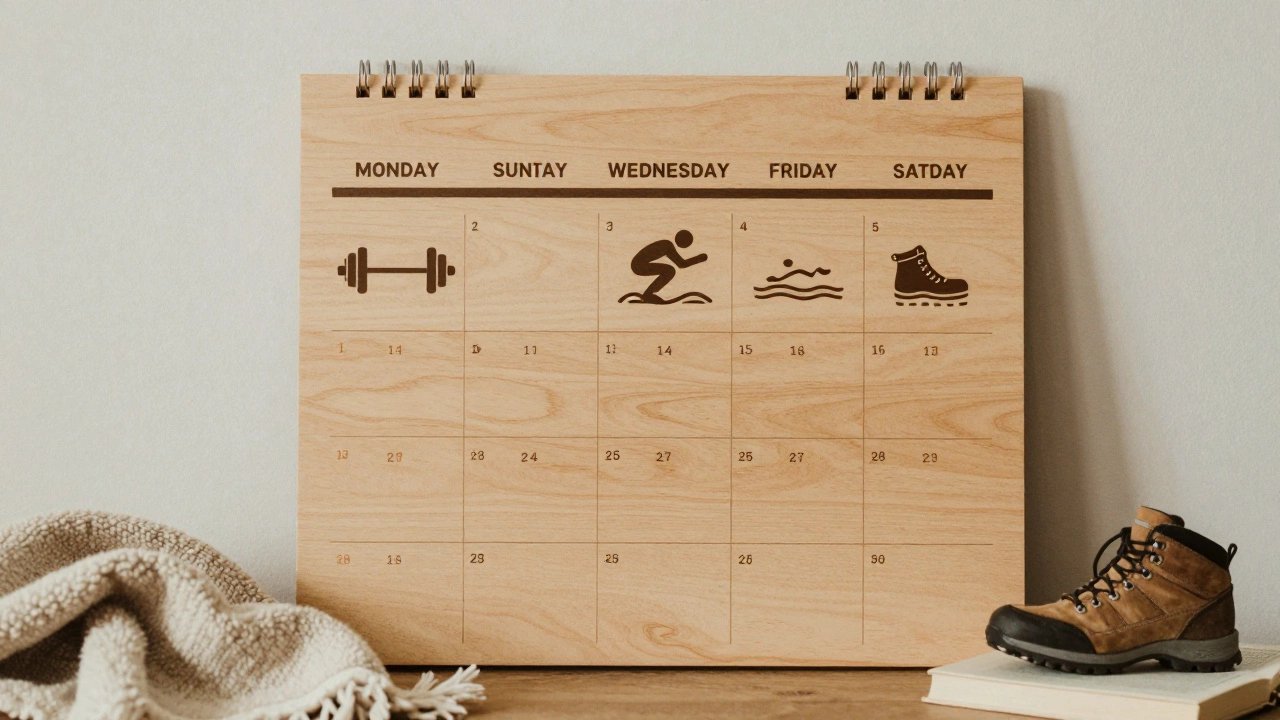
- Monday: Strength (Upper Body) - Pull-ups, bench press, rows, shoulder work. Focus on control, not ego-lifting.
- Wednesday: Strength (Lower Body) - Deadlifts, squats, lunges, core stability. These movements build functional power.
- Friday: Cardio + Mobility - A 45-minute brisk walk, swim, or rowing session. Followed by 15 minutes of stretching or yoga. This isn’t about burning calories - it’s about circulation and joint health.
- Saturday (Optional): Active Recovery - A long hike, a bike ride, or a light session of calisthenics. No heavy weights. No intensity. Just movement.
This structure gives you four focused sessions, with a built-in buffer. If life gets hectic - a late meeting, a sick child, a travel delay - you can skip Saturday without guilt. You’re still hitting the critical three days. And that’s enough.
Why Three to Four Days Is Enough
Think of fitness like fine tailoring. You don’t need a new suit every week. You need one that fits well, lasts, and is cared for. The same applies to your body.
When you train three to four times a week, you allow time for:
- Deep recovery - Muscles repair, inflammation lowers, nervous system resets.
- Consistent sleep - No more 11 p.m. workouts that leave you wired.
- Improved focus - You’re not mentally exhausted from constant training.
- Sustainable habits - You’re not chasing a 30-day challenge. You’re building a lifetime.
Men who train this way don’t look like bodybuilders. They look like men who’ve aged well - strong shoulders, steady posture, calm energy. That’s the standard worth pursuing.
What to Avoid
There are three common traps that derail men’s fitness - not because they’re lazy, but because they’re misled.
- Training through pain - If your knee aches after squats, it’s not weakness. It’s a warning. Adjust form, reduce load, or take a week off. A year from now, you’ll be glad you did.
- Comparing yourself to social media - That guy posting six-day splits? He’s probably not working full-time, raising kids, or sleeping seven hours. His routine isn’t your blueprint.
- Thinking cardio is the only way to get lean - You don’t need to run 5K every morning to lose fat. Strength training builds metabolism. Nutrition does the rest.

Progress, Not Perfection
There’s no magic number. Some men thrive on five days. Others do better with two. The key is to observe. Keep a simple log: energy levels, sleep quality, mood, recovery time. After four weeks, ask yourself: Do I feel stronger? More alert? Less stiff?
If the answer is yes, you’re on the right track. If you’re drained, it’s time to cut back.
True discipline isn’t about showing up every single day. It’s about showing up when it matters - when your body needs it, when your mind is ready, and when you can give it your full attention.
The Gentleman’s Standard
There’s an old saying: "A man’s strength is not in how hard he pushes, but in how wisely he sustains."
For the modern gentleman, fitness isn’t about aesthetics. It’s about presence. It’s about having the stamina to walk through life without wincing, without fatigue, without excuses. It’s about looking in the mirror and seeing someone who’s not just fit - but composed.
So don’t chase volume. Chase balance. Three solid days. One active day. Two rest days. That’s not a compromise. It’s a strategy.
And that’s how you build a body that lasts - not just for the next six months, but for the next thirty years.