

Healthy Masculinity Self-Assessment
How do you practice healthy masculinity?
Answer these 5 questions honestly to understand where you stand. No right or wrong answers—this is about your personal growth.
Your Healthy Masculinity Score
Total Score: 0/20
For generations, masculinity was defined by silence. By stoicism. By the unspoken rule that a real man doesn’t flinch, doesn’t ask for help, doesn’t show weakness. That version of manhood didn’t protect men-it isolated them. And today, too many are still paying the price.
The Cost of the Old Script
Men in the UK are three times more likely to die by suicide than women. That’s not a statistic about mental illness alone-it’s a symptom of a cultural expectation that has outlived its usefulness. When you’re taught that vulnerability is failure, you learn to bury your pain under work, alcohol, or anger. You stop talking. You stop listening-to others, and to yourself.
There’s nothing noble in suffering alone. And there’s nothing strong about pretending you’re fine when you’re not. Healthy masculinity isn’t about rejecting strength-it’s about redefining it. Real strength is the courage to say, ‘I’m not okay,’ and the discipline to do something about it.
What Healthy Masculinity Looks Like
It’s not loud. It doesn’t need to prove itself. It shows up quietly, consistently, and with integrity.
- It’s a man who walks into therapy not because he’s broken, but because he’s committed to becoming better.
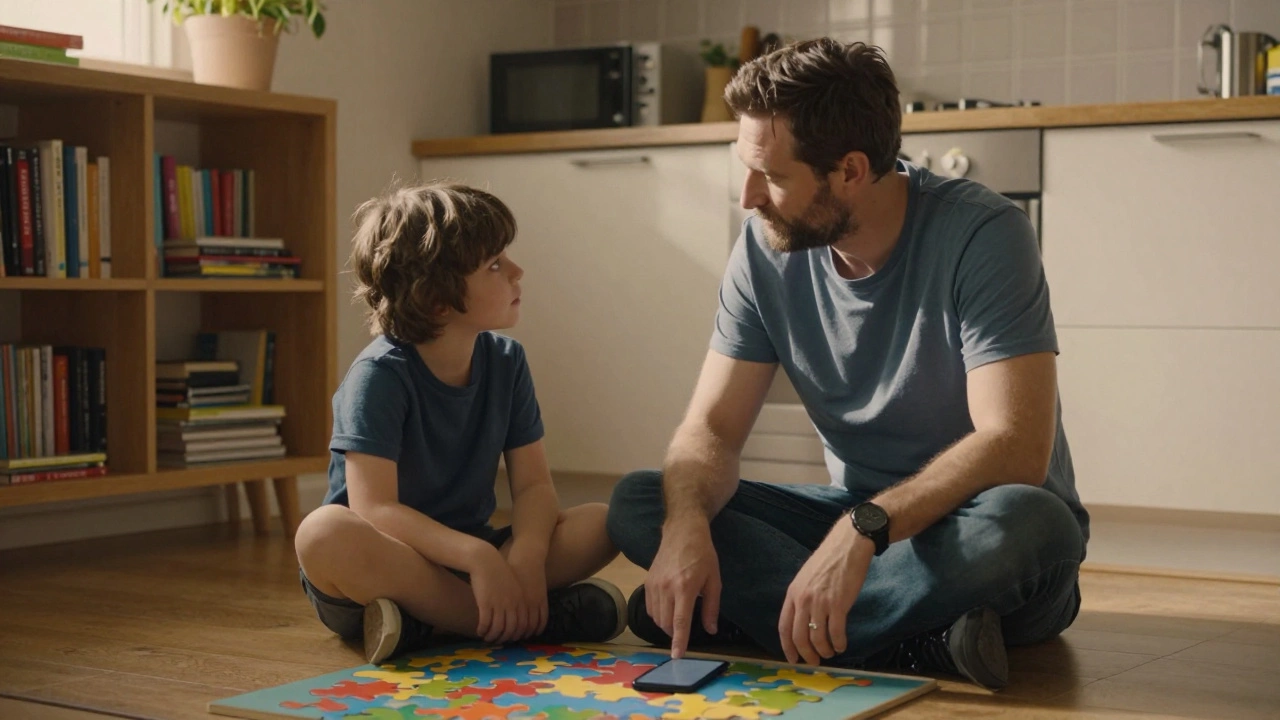
- It’s a father who puts his phone down at dinner and asks his son, ‘How was your day?’-and actually listens to the answer.
- It’s a colleague who says, ‘I need some time to think,’ instead of pretending he has all the answers.
- It’s a husband who admits he’s scared-about his career, his aging parents, his future-and doesn’t see that as a flaw, but as a human truth.
Healthy masculinity is not the absence of emotion. It’s the mastery of it. It’s knowing when to lead, when to listen, when to hold space for someone else’s pain, and when to ask for your own.
Breaking the Patterns
Changing how you see yourself as a man doesn’t happen overnight. It starts with small, daily choices.
- Replace ‘I’m fine’ with ‘I’m learning.’ The moment you stop pretending you have everything figured out, you open the door to growth.
- Build a circle of trusted men. Not friends who just drink with you, but men you can call when you’re struggling. One or two is enough. Quality over quantity.
- Practice emotional literacy. Learn to name your feelings. Not just ‘stressed’ or ‘angry,’ but ‘overwhelmed,’ ‘disappointed,’ ‘lonely.’ The more precise you are, the less power those emotions have over you.
- Set boundaries with toxic masculinity. If a joke at work makes you uncomfortable, say so. If someone mocks vulnerability, don’t laugh along. Your silence gives permission. Your voice changes the culture.
- Take care of your body like you take care of your mind. Sleep, movement, nutrition-they’re not just physical. They’re mental hygiene. A tired, sluggish body makes a tired, sluggish mind.
Examples in the Real World
Look at the men who’ve quietly reshaped what it means to be strong. The CEO who shares his anxiety in a company-wide email-not to seek sympathy, but to normalise the conversation. The teacher who hugs his students without fear of judgment. The veteran who speaks openly about PTSD in a local men’s group, not as a victim, but as someone who’s healing.
These aren’t outliers. They’re the new standard.
And they didn’t become that way by shouting louder. They became that way by showing up-honestly, consistently, and with quiet dignity.

Where to Start
You don’t need to overhaul your life. You just need to begin.
Start today. Pick one thing:
- Call a friend you haven’t spoken to in months-not to catch up on news, but to ask how they’re really doing.
- Write down three emotions you felt this week. Don’t judge them. Just name them.
- Schedule a 30-minute walk alone, no phone, no playlist. Just your thoughts.
These aren’t grand gestures. They’re quiet acts of rebellion against an outdated ideal. And they matter.
It’s Not About Being Perfect
Healthy masculinity isn’t about being the strongest, the loudest, or the most successful. It’s about being real. It’s about showing up as a whole man-not just the parts society told you to display.
There’s no finish line. There’s no medal. There’s just the daily choice to be kinder to yourself, to be braver with your truth, and to lead not by force, but by example.
That’s the quiet power of modern manhood. And it’s the only kind worth building.
Is healthy masculinity the same as being soft?
No. Healthy masculinity isn’t about being soft-it’s about being whole. Softness without strength is passivity. Strength without compassion is brutality. Healthy masculinity blends both: the discipline to act, and the humility to feel. It’s the man who holds the door open, listens without fixing, and still leads when it matters.
Can a man be successful and still struggle with mental health?
Absolutely. Success doesn’t immunise you from pain. Many high-achieving men carry silent burdens-pressure to perform, fear of failure, loneliness at the top. The most successful men aren’t the ones who never struggle. They’re the ones who know how to manage it-through therapy, routine, mentors, or simply admitting they need help.
How do I talk to my dad or older male relative about this?
Start with respect, not correction. Say something like, ‘I’ve been thinking about what it means to be a good man, and I’ve realised it’s not about being tough all the time. I’d love to hear how you’ve learned to handle hard moments.’ You’re not challenging his past-you’re inviting him into a new conversation. Many older men want to understand but don’t know how to begin.
Is therapy only for people with serious problems?
No. Therapy is like regular check-ups for your mind. You don’t wait until your teeth are rotting to visit the dentist. Similarly, you don’t wait until you’re in crisis to talk to a professional. Many men use therapy to navigate career transitions, relationship stress, or simply to understand themselves better. It’s a tool for growth, not a sign of failure.
What if I’m worried people will think I’m weak for opening up?
Real strength isn’t about what people think-it’s about what you know to be true. The people who judge you for being open aren’t the ones you want in your circle anyway. The ones who matter will respect you more for it. And over time, your honesty will give them permission to be honest too. That’s how change spreads-not through speeches, but through quiet, consistent example.